

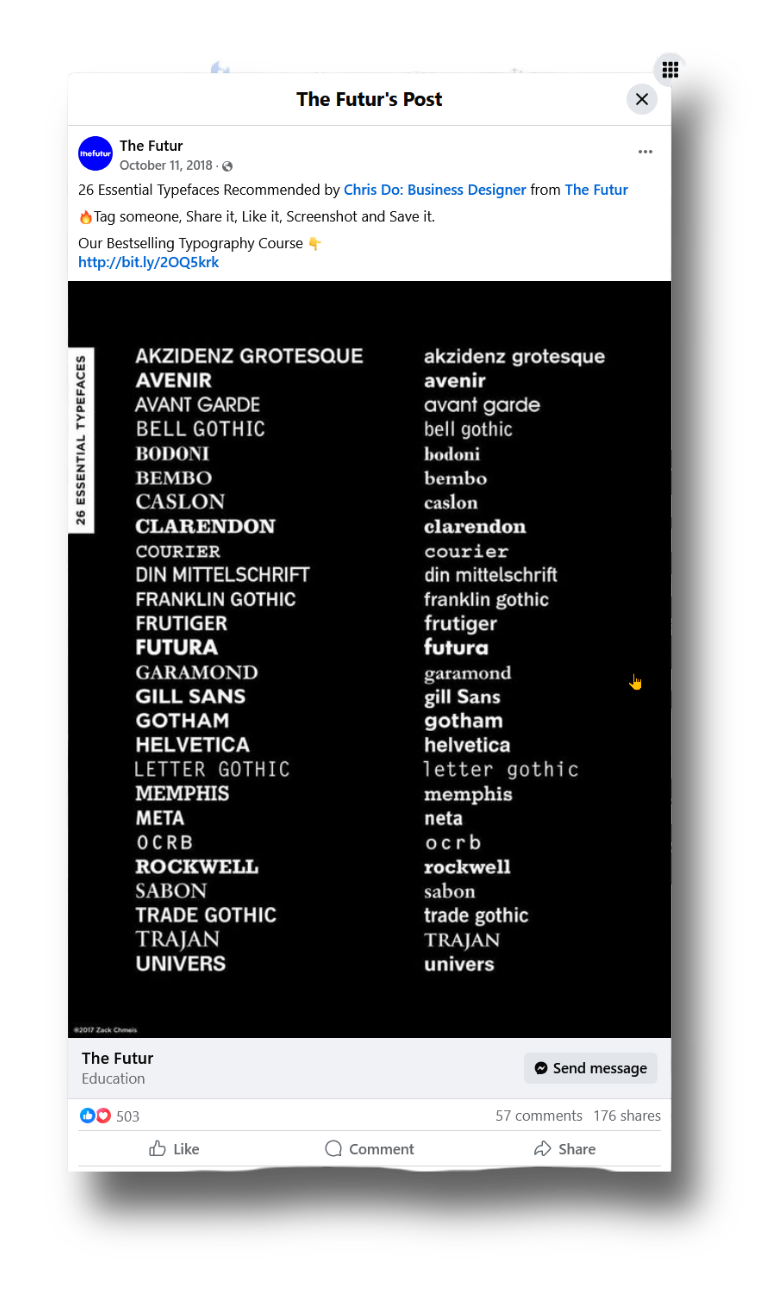
If you're at the stage of picking a font, why not pick the right one straight away? Fonts might not single-handedly make or break your business, but if you're at this crucial stage of choosing, and it's important for your branding, spending a bit of time to get it right is surely worthwhile. In this post, I'll share Chris Do's recommended fonts. You'll see the list, and hopefully, you can find one that truly works for you and your message. A quick note: while the ScoreApp platform (which I'll discuss later for its benefits in client alignment) may not directly support embedding all of these specific custom fonts in its quiz interfaces, understanding these typefaces gives you a great foundation for your overall branding. The principles of good typography definitely inform how you present yourself, even when using tools with their own font selections.
A Foundation for Clear Expression: Chris Do's 26 Essential Typefaces
Chris Do’s list has always struck me as a thoughtful compilation of typefaces that offer both versatility and enduring quality. For anyone engaged in communicating visually, these can serve as a robust foundation:
Akzidenz Grotesque
Avenir
Avant Garde
Bell Gothic
Bodoni
Bembo
Caslon
Clarendon
Courier
DIN Mittelschrift
Franklin Gothic
Frutiger
Futura
Garamond
Gill Sans
Gotham
Helvetica
Letter Gothic
Memphis
Meta
OCRB
Rockwell
Sabon
Trade Gothic
Trajan
Univers
Exploring this collection, one finds a spectrum of expression – from the directness of Akzidenz Grotesque to the elegance of Bodoni, the clarity of Frutiger, and the timeless geometry of Futura. Developing a familiarity with these typefaces, understanding their nuances and intended uses, can significantly deepen the intentionality and effectiveness of our visual communication.
Why These Typographic Choices Matter for Meaningful Outcomes
The value of these typefaces, as I see it, extends beyond their surface appearance. They embody principles that contribute to more meaningful and effective communication:
Versatility for Coherence: Many offer extensive families, allowing for harmonious visual systems to be built with clarity and consistency.
Enduring Principles: These forms have proven their ability to communicate effectively across time, embodying timeless design principles rather than fleeting trends.
Clarity Above All: At their core, these typefaces are designed to convey messages with ease and precision, supporting the primary goal of understanding.
Nuances of Expression: Each carries a distinct essence, enabling the reflection of varied tones and characteristics appropriate to the message at hand.
When we engage with these tools with awareness, we are better equipped to create communications that not only look refined but also serve their intended purpose with greater impact.
Beyond Form: Cultivating Alignment for More Resonant Work (and how ScoreApp might support this)
So, we have these wonderful tools for expression. But how do we ensure that the work we put into the world finds its intended audience and purpose in a truly aligned way? This is less about "finding the right clients" in a transactional sense, and more about fostering connections where mutual understanding and shared goals can flourish. It's often the quality of this alignment that dictates the true success and fulfillment we find in our endeavors.
I’ve observed that much time and energy can be spent in interactions where there isn't a clear resonance from the outset. This isn't about fault, but about fit. The question then becomes: how can we create a process that gently guides interactions towards greater clarity and mutual understanding, ensuring that collaborations are fruitful for all involved? This is where I see the potential value in systems that facilitate better initial understanding, and a platform like ScoreApp offers functionality that can be used in this spirit, focusing on the process of alignment.
My intention here isn't to highlight a product, but to explore a way of approaching these initial interactions that can lead to more harmonious outcomes. Consider these possibilities:
Inviting Self-Reflection and Shared Understanding:
What if, instead of a direct pitch, we could offer a structured way for potential collaborators to explore their own needs and vision? Using a tool like ScoreApp, one might craft a thoughtful questionnaire—perhaps a "Project Clarity Guide" or a "Values Alignment Explorer." This isn't about testing them, but about providing a shared space for reflection that can illuminate the path forward for everyone. The aim is to foster mutual insight from the very beginning.
Guiding Towards Resonant Collaborations:
The true benefit I see in such tools is their capacity to help reveal whether a potential collaboration has a strong foundation of shared purpose. By thoughtfully structuring initial interactions, perhaps through the kind of guided discovery that ScoreApp can facilitate, we can more easily discern where true synergy lies. It's about creating pathways for connections that are genuinely meant to be, leading to work that feels less like a struggle and more like a co-creation. This allows everyone to invest their energy where it will be most valued and effective.
Deepening the Initial Dialogue:
When an interaction begins with a degree of shared clarity, subsequent conversations can be far more meaningful and productive. Having some mutual understanding of needs, aspirations, and perspectives allows for a dialogue that starts from a place of greater depth, respect, and efficiency.
Reflecting Professional Care:
Any process that demonstrates thoughtfulness, clarity, and a genuine interest in mutual understanding naturally enhances the perceived quality and care one brings to their work. This can set a positive tone for any potential collaboration.
Exploring methods that enhance alignment, possibly supported by platforms like ScoreApp, is, from my perspective, about nurturing the conditions for our best work to emerge and to serve its highest purpose. It's about ensuring that our skills and dedication are applied in contexts where they can truly make a positive difference.
Final Reflections: Typography, Connection, and Purposeful Work
Developing a keen understanding of typographic principles and tools like those highlighted by Chris Do is undoubtedly valuable for anyone committed to clear and impactful communication.
However, the ultimate fulfillment in our work often comes when these skills are applied in collaboration with others who share a similar vision and respect for the process. Seeking better alignment in our professional relationships – perhaps aided by thoughtful approaches to initial engagement as one might design with ScoreApp – isn't just a business strategy. It's a way to cultivate more meaningful, resonant, and purposeful outcomes in all that we do.
My hope is that by considering both the tools of our craft and the way we connect with others, we can all move towards work that is not only effective but also deeply satisfying and aligned with a broader sense of purpose.

